The Connection Between Grounding and Sleep
If you've been struggling with restless nights, racing thoughts at bedtime, or waking up feeling unrested, you're far from alone. Sleep disorders affect roughly 50 to 70 million adults in the United States alone. While conventional solutions range from medication to cognitive behavioral therapy, a growing number of people are turning to a surprisingly simple practice: grounding, also known as earthing.
Grounding involves making direct electrical contact with the Earth's surface. When you walk barefoot on grass, swim in the ocean, or sleep on a conductive grounding sheet, free electrons from the Earth flow into your body. Proponents and researchers suggest these electrons may help neutralize free radicals and restore the body's natural electrical balance — with sleep being one of the most commonly reported benefits.
But does the science actually support these claims? Let's look at what the research says.
What the Research Says About Grounding and Sleep
The Cortisol Connection
One of the most cited studies on grounding and sleep was published in 2004 in the Journal of Alternative and Complementary Medicine. Researchers measured cortisol levels in 12 participants over an 8-week period. Cortisol, often called the "stress hormone," follows a natural 24-hour cycle — it should peak in the morning and drop at night to allow restful sleep.
The study found that participants who slept grounded showed a significant normalization of their cortisol rhythm. Their nighttime cortisol levels dropped, aligning more closely with the natural circadian pattern. Participants also reported improvements in sleep quality, pain reduction, and reduced stress.
While this was a small study, the measurable changes in cortisol profiles are noteworthy because cortisol dysregulation is strongly linked to insomnia, frequent nighttime awakenings, and poor sleep quality.
Subjective Sleep Quality Improvements
A larger observational review by Ober, Sinatra, and Zucker compiled feedback from over 5,000 individuals who used grounding products. Among the reported outcomes:
- Approximately 85% reported falling asleep more quickly
- About 93% reported improved sleep quality overall
- Around 82% experienced a reduction in muscle stiffness and soreness
- Nearly 74% reported a reduction in chronic back and joint pain
These are self-reported results, which means they should be interpreted with caution. However, the consistency across thousands of users is difficult to dismiss entirely.
Autonomic Nervous System Effects
A 2011 study published in Integrative Medicine: A Clinician's Journal examined the effects of grounding on the autonomic nervous system. Researchers found that grounded participants showed increased parasympathetic activity — the "rest and digest" mode — compared to ungrounded controls. This shift toward parasympathetic dominance is exactly what the body needs to transition into deep, restorative sleep.
How Grounding May Improve Your Sleep
Based on the available research, grounding may support better sleep through several mechanisms:
1. Cortisol Regulation
As the 2004 study demonstrated, grounding during sleep may help normalize your cortisol curve. When cortisol drops appropriately at night, your body can more easily enter and maintain deep sleep stages. If you find yourself waking up alert at odd hours — for instance, waking up at 3 AM — cortisol spikes may be part of the problem.
2. Reduced Inflammation
Chronic low-grade inflammation is associated with poor sleep quality. Research suggests that the free electrons absorbed during grounding may act as natural antioxidants, potentially reducing inflammatory markers. When systemic inflammation decreases, the body may find it easier to relax into sleep.
3. Nervous System Calming
The shift toward parasympathetic nervous system activity observed in grounding studies means your body is better primed for rest. If you tend to lie in bed with a racing heart or buzzing mind, grounding may help activate the calming branch of your nervous system.
4. Pain Reduction
Pain is one of the most common disruptors of sleep. Multiple studies and user reports suggest grounding may reduce pain perception, which can directly translate to fewer nighttime disruptions and more continuous sleep.
How to Ground Yourself for Better Sleep
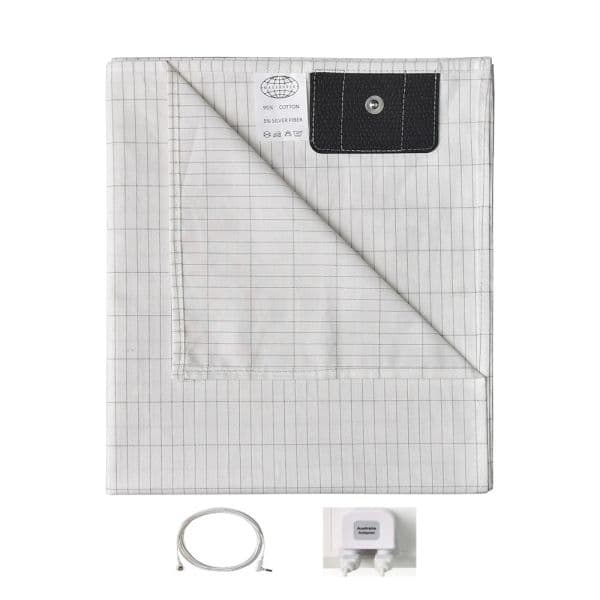
The most practical way to ground yourself during sleep is with a grounding sheet. These sheets contain conductive silver or carbon fibers woven into the fabric and connect to the grounding port of your wall outlet via a grounding cord.
Here's a simple approach to get started:
- Choose the right size: A queen grounding sheet or king grounding sheet covers your sleeping surface so you make contact naturally as you move during sleep.
- Set up correctly: Place the grounding sheet on top of your mattress (under your fitted sheet is also fine if the fitted sheet is thin cotton). Connect the cord to a grounded outlet. Use a grounding tester to verify your outlet is properly grounded.
- Maximize skin contact: Sleep with bare skin touching the sheet — arms, legs, or torso. Avoid thick synthetic pajamas that could block conductivity.
- Be consistent: Use it every night. The cortisol study showed improvements building over weeks of consistent use.
For a complete walkthrough, see our step-by-step grounding sheet setup guide.
What to Expect: A Realistic Timeline
Not everyone responds the same way. Here's a general timeline based on user reports and study data:
- Night 1-3: Some people notice a calming sensation or feel slightly different. A few may experience a temporary "adjustment period" with unusual dreams or mild tingling.
- Week 1-2: Many users report falling asleep faster and waking less during the night.
- Week 3-4: Deeper sleep, feeling more rested upon waking, and reduced daytime fatigue are commonly reported at this stage.
- Month 2+: Sustained improvements in sleep quality and often secondary benefits like reduced stiffness and improved mood.
Limitations and Honest Caveats
It's important to be transparent about the current state of grounding research:
- Most studies are small in scale — larger, randomized controlled trials are needed.
- Grounding is not a cure for insomnia or any sleep disorder. It may be a helpful complementary practice.
- Individual results vary. Some people notice dramatic improvements; others notice subtle or no changes.
- If you have a serious sleep disorder, consult a healthcare professional. Grounding does not replace medical advice or treatment.
That said, grounding during sleep carries virtually no risk. A conductive sheet is simply a bedding product — there are no side effects in the way medication might produce them. For many people, the potential upside makes it well worth trying.
The Bottom Line
The research on grounding and sleep, while still emerging, is genuinely encouraging. Measurable cortisol changes, parasympathetic nervous system activation, and consistent self-reported improvements across thousands of users all point in the same direction: grounding during sleep may meaningfully improve sleep quality for many people.
If you're interested in trying it, a sleep starter kit is the simplest way to begin. It includes everything you need — a grounding sheet, cord, and outlet tester — so you can start grounding tonight.